Εμφάνιση αναρτήσεων με ετικέτα orthopedic reflexology speculation. Εμφάνιση όλων των αναρτήσεων

Τετάρτη 2 Απριλίου 2025

Fascial Hydration: Why It’s More Than Just Drinking Water

In the Orthopedic Reflexology training we utilize Hippocrates guidelines found in paragraph 17 regarding the application of our manual techniques. Depending on which techniques and how we apply them we have different results.

"Frictions can relax, brace, incarnate, attenuate: hard braces, soft relaxes, much attenuates, and moderate thickens." Hippocrates

One desired result is hydrating or rehydrating the soft tissues of the feet or other areas (hands, ear, and face) where our reflexes are found.  If one reflex area feels dehydrated a reflexologist will assume that the represented organ, joint, muscle or other will also be dehydrated. And it was Eunice Ingham regarding circulation that said 

"Stagnation is death, circulation is life!"

Following are small excerpts from a very informative article on fascial hydration by Yasmin Lambat

Fascia researcher Carla Stecco explains that fascia has a viscoelastic property, allowing it to glide and adapt with movement (Stecco 2015).  This property is largely dependent on hyaluronan, a molecule that absorbs and retains water within the fascial matrix. But here’s the catch: fascia doesn’t hydrate itself through drinking alone. It needs movement—especially gentle, fluid movements like fascial unwinding—to allow water and nutrients to circulate properly. Without movement, the fascial matrix can become dry, sticky, and less responsive, leading to stiffness, pain, and a lack of mobility.

Modern life tends to limit the kind of varied, fluid movement our fascia needs. Sitting for long hours, repetitive motions, and chronic stress can cause fascia to lose its natural elasticity and hydration. When fascia becomes dry, it creates adhesions—areas where tissues stick together and restrict movement. 

Fascial hydration is about dynamic hydration—the ability of your fascia to absorb and distribute fluids effectively. Gentle, whole-body movements that engage the fascia—like undulating, spiraling, and slow, mindful stretching—help stimulate the


flow of interstitial fluid (the fluid between cells), ensuring the fascial system stays supple and responsive.

Simple Ways to Hydrate Your Fascia

  1. Micro-Movements: Small, spontaneous movements (such as gentle rocking or unwinding) can encourage fluid movement within the fascia.
  2. Restorative Movement Practices: Practices like fascial unwinding, somatic movement, and slow, non-linear stretching support hydration at a deep level.
  3. Body Awareness: Tuning into subtle sensations and moving with ease rather than force encourages the body’s natural fluid flow.
  4. Hydration with Purpose: While drinking water is essential, it’s even more effective when paired with mindful movement that distributes hydration where it’s needed.

Τετάρτη 22 Ιανουαρίου 2014

Orthopedic Reflexology speculation

A few days ago a discussion begun in a facebook group regarding reflexology. The discussion follows, and though it is difficult to 100% understand what is being said (possibly if descriptions where made in terms of skeletal anatomy this would be easier) I find this challenging and have dicided to tackle it through an Orthopedic Reflexology rationale.  

- Very interesting reaction today. Right in the centre of the median arch of the foot almost on the foot itself was a very sensitive spot which gave the client severe cramping. Fortunately it is a reacton she was already aware of and apologised for not telling me! Was able to work the rest of the area and from kidney, down urinary tract to bladder with no issues. Only thing I could think of is that it is linked to her IBS. She also had very sensitive areas at the thoracic/lumbar area with no reported back issues. Possibly linked to the IBS via inneravation?
- Also I was able to ease the pain on the spinal reflex with a few seconds of soft pressure.

- The area you describe sounds like the end and beginning (on each foot) of the transverse colon (if I'm understanding your description correctly) so this would make perfect sense that it was associated with her IBS. Sometimes reflexes are not in exactly the same spot on the feet from one client to another as indeed they do vary slightly in the body itself. As the colon is a muscle it could also make sense that the foot was cramping when the bowel reflex was worked on - as the bowel may have been cramping at the same time. Be interested to here other theories too.

- Yes, I also linked the cramping in her foot and the spasmodic nature of IBS. Although then I wondered if that was too obvious!


So let us begin by detecting the spot that triggered the cramping. 
If I have understood correctly, the area at hand would be the reflex area for the large intenstine (transverse colon) in the 1st zone (Right in the centre of the median arch). This would be around the joint medial cuneiform and navicular bones. This area is a "tricky one", it has been referred to as a zone of confusion! The zone is illustrated in the picture (right).

Here, due to the confusion, it is proven how essential it is to observe and notice the result of the cramping. The "result" will tell us which muscle(s) are associated and following the zone and meridian. What could follow is initially placing/naming the reflex area and then working this area out, either it being a reflex area, a muscle, a tendon sheath, a nerve sheath,  or trigger point.

Red structures are solar plexus and mesenteric plexus according to Nerve reflexology and Hanne Marquardt mapping. Adrenals are somewhere there also!

So if the 1st toe plantar flexed it would be the flexor hallucis longus tendon with the associated brevis hallucis muscle.
If the foot everted and plantar flexed it would be the peroneus longus tendon .
If the foot inverted and plantar flexed it would be the tibialis posterior muscle as "The main portion inserts into the tuberosity of the navicular and the plantar surface of the first cuneiform." 
The latter seems the most attractive hypothesis because the Reflexologists asking states: 
1st "Also I was able to ease the pain on the spinal reflex with a few seconds of soft pressure. = insertion of main protion. 

And 2nd  "She also had very sensitive areas at the thoracic/lumbar area with no reported back issues."
And this tendon has attachments as described: The plantar portion inserts into the bases of the second, third and fourth metatarsals, the second and third cuneiforms and the cuboid.

Now there is this issue with the clients IBS - Irritable bowel syndrome, and all visceral issues that proceed well with the "complementary help" of Reflexology! 

In their book, Barral and Croibier (pg 10) describe something interesting having to do with the plantar  and palmar surface of the feet and hands, exactly the areas reflexologists focus their work on.  
 “These dysfunctions are found typically at the distal ends of the extremities; They mainly occur when nerves with a high neurovisceral portion* are involved, like the median nerve or the tibial nerve.”
*Of or relating to innervation of the internal organs by the autonomic nervous system.


Tibial innervation all the way!


So there is possibly an association between this clients IBS and the cramping in her feet, but is there also vice versa the "therapeutic handling" of her IBS symptoms through her feet?
HYPOTHESIS
If we Reflexologists "work" on the soles of the feet (reflex map), we are also working on the cutaneous innervation to the sole of the foot which is provided by the tibial nerve which has a high neurovisceral portion. When we do this in an appropriate way, staying in the pain limits (hedonic tone = hurts good!) of our client, is it possible to alleviate this womans IBS symptoms?
 I do not utilize the word "cure" because as Hippocrates states in his 1st aphorism, it is not all up to us!  

Aphorisms

Section I

Life is short, and Art long; the crisis fleeting; experience perilous, and decision difficult. The physician must not only be prepared to do what is right himself, but also to make the patient, the attendants, and externals cooperate.

There is also one more comment which is quite accurate but needs even more highlighting, "Sometimes reflexes are not in exactly the same spot on the feet from one client to another as indeed they do vary slightly in the body itself."


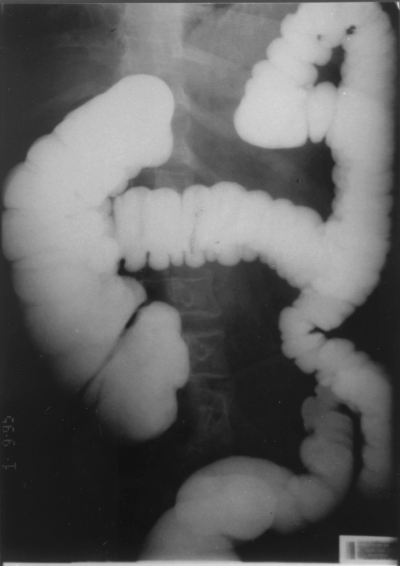
"Have a look at these pictures, does the large intenstine look anything like the one on the reflexology chart you where taught in Reflexology school? " 

No worries Reflexology friends, either way your experienced hands are guiding you, and when in doubt always, always remember Eunice Ingham's aphorism, we (modern day reflexologists) have shown her enough diesrespect!


In conclusion I still have a "gut feeling" that the structure(s) at hand is/are the lumbricals and the Flexor digitorum longus muscle

but I would need to know what was the result of the cramping to have a better idea.
Well as Hippocrates said in his 1st aphorism 
Life is short, and Art long; the crisis fleeting; experience perilous, and decision difficult.