Εμφάνιση αναρτήσεων με ετικέτα ρεφλεξολογια. Εμφάνιση όλων των αναρτήσεων

Τρίτη 4 Μαρτίου 2025

Ημερίδα Ρεφλεξολογίας εις μνήμην της Αλεξάνδρας Κολοβού πρωτοπόρος της Ρεφλεξολογίας στην Ελλάδα

Τον Φεβρουάριο του 2024 έφυγε από την ζωή η κ. Αλεξάνδρα Κολοβού πρωτοπόρος της Ρεφλεξολογίας στην Ελλάδα.

Ένα χρόνο μετά, και με πρωτοβουλία των παιδιών της, θα πραγματοποιηθεί ημερίδα με θέμα "Το παρελθόν και το μέλλον της Ρεφλεξολογίας στην Ελλάδα".

Η συμμετοχή στην ημερίδα είναι ΔΩΡΕΑΝ και όλα τα έξοδα έχουν καλυφθεί από την οικογένεια της Αλεξάνδρας Κολοβού.

Κατόπιν επιθυμίας της οικογένειας, και τα τρία σωματεία Ρεφλεξολογίας  συνεργάστηκαν για τον σχεδιασμό της ημερίδας.

Συνολικά 100 άτομα θα μπορούν να παρακολουθήσουν την ημερίδα και κάθε σωματείο θα έχει στην διάθεση του 33 προσκλήσεις.
Δεν θα υπάρξει δυνατότητα για διαδικτυακή παρακολούθηση.

Στις 9:30πμ θα συγκεντρωθούμε στο ξενοδοχείο Στράτος Βασιλικός Μιχαλακοπούλου 114 όπου θα προσφερθεί καφές, τσαί και θα έχουμε ευκαιρία να δούμε παλιούς φίλους αλλά και να γνωριστούμε μεταξύ μας.

Στις 10:00πμ θα ξεκινήσουμε με χαιρετισμό από την οικογένεια της κ. Κολοβού και στην συνέχεια θα ακολουθήσουν οι ομιλίες των 

Μάρδα Ευφροσύνη Στραβελάκη
Θέμα: «Η συμπόρευσή μας στο μονοπάτι της
Ρεφλεξολογίας με τη φίλη και συνάδελφο Αλεξάνδρα».
Μιχάλη Κυριακίδη
Θέμα: «Η εξέλιξη της Ρεφλεξολογίας μέσα από την
οπτική της Αλεξάνδρας Κολοβού».
Δημητράκουλας Σπύρος
Τίτλος: Αλεξάνδρα Κολοβού - Πιο επίκαιρη από ποτέ! Αναλύοντας το βιβλίο της "Ανακλαστική Ζωνοθεραπεία": Σκέψεις, προβληματισμοί και συμπεράσματα.

Γκατζούνης Θεόδωρος
Τίτλος: Επιστημονική τεκμηρίωση των μικροσυστημάτων στο ανθρώπινο σώμα και η σημασία τους στην υγεία.

Δρακόπουλος Γρηγόρης
Τίτλος: Η αρχαία ελληνική λύρα και η θέση της στον στοχαστικό ορίζοντα της ιπποκρατικής θεραπείας 


Δείτε την κ. Κολοβού όπου μίλησε στην ημερίδα του ΣΕΡ το 2012


Διαβάστε την συνέντευξη της στο περιοδικό Εναρμόνιση τεύχος 19 του ΣΕΡ

https://www.reflexology.gr/wp-content/uploads/2018/08/enarmonisi-19.pdf

Κυριακή 10 Ιουλίου 2022

Spiros Dimitrakoulas on Orthopedic Reflexology "In the footsteps of Hippocrates" interview with Toine de Graaf for NATUURLIJKE GEZONDHEIDSZORG

There were some requests from some colleagues to read this interview from a while back in the Dutch languge.
With the help of google translate and to the best of my memory I have prepared the following translation.

A link to a pdf of the original article may be found here. 

Journalist Toine de Graaf has specialized in (complementary) healthcare. After employment with a nursing journal and a daily newspaper, he chose in 1996 a freelance existence. He has contributed about sixty articles (newspapers and magazines). His book “The power of the alternatives.” was published in 2016.


Spiros Dimitrakoulas is a famous name in the world of Reflexology. He was president of the Greek professional association (Hellenic Association of Reflexology) and also of the RiEN (Reflexology in Europe Nexus). As a reflexologist he specializes in pain, sports and the elderly. In addition to his practice in Argos and Athens he teaches Reflexology.

He also provides training in Orthopedic Reflexology (OR). A specialization that he developed himself and with which he elaborates on the work of an illustrious compatriot: Hippocrates has already written about "the art of rubbing".


The Greek physician Hippocrates of Kos (c. 460 BC. – 370 BC) is commonly
seen 
as the "father" of Western medicine. He made a diagnosis based on physical symptoms and prescribed therapy.
This was new in his time, when diseases were often attributed to supernatural causes, like the Gods.

In 2020 Hippocrates is still a source of inspiration, both within conventional medicine and in the CAM field. For example, every doctor and therapist takes the Hippocratic Oath, in which professional morality is laid down. Hippocrates also said: "Our food is our medicine, and that medicine is our food." a view that is widely embraced within natural health care.

Some complementary therapists evolve on their own way based on the work
of Hippocrates. Like Spiros Dimitrakoulas, who is the originator of 
Orthopedic Reflexology which was inspired by his prominent compatriot. For this he immersed himself in the'Corpus Hippocraticum', a collection of writings for which Hippocrates laid the foundation. In addition, he also used the work of Claudius Galenus, an influential Greek/Roman physician who adopted Hippocrates' ideas. 

'Also interesting is what the Roman writer Aulus Cornelius Celsus reports in his medical encyclopedia, which dates from the year 25 A.D., says Spiros.


Celsus often refers to the ancient Greek doctors. He describes, among other things, the rubbing of the limbs to free head and body of 'residues'. Fascinating is also what he reports about cross reflexes: the rubbing of one limb to help the other limb. A principle that is still widely used by Reflexologists.

Scattered throughout the Corpus Hippocraticum, many references can be found to rubbing and to feet," Spiros continues further.


Hippocrates speaks of the art, in this context,of rubbing, or 'Anatripsis' the word used back then. He regarded that the art of rubbing was easy to learn and apply.”

The passages about rubbing, are according to Spiros of huge importance to any therapist who does bodywork. Hippocrates writes that hard rubbing tightens and binds. Gentle rubbing loosens. That is still very recognizable.

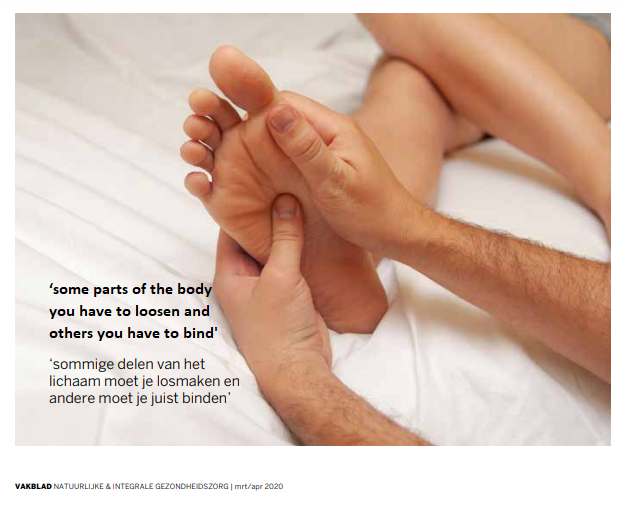
Take a common complaint such as 'frozen shoulder'. That shoulder is immobile, for which gentle rubbing is recommended. Some parts of the body you have to loosen and others you have to bind correctly. I have tested and successfully applied the principles found in the Greek texts on the feet in Reflexology. And now I train people in that.”

Last fall he did that in Almere, by invitation by reflex zone therapist Nancy Klein. For three days, Spiros taught students in his Orthopedic Reflexology (OR).

The term 'orthopedic' is made up of the Greek concepts of 'ortho' (straight or correct) and 'pedis' (feet). It is therefore different from the term used in medicine'orthopaedic'.


This can be achieved by following the guidelines of Hippocrates for the manual work. Reflexologists are not massage therapists. But still we do work with the tissues of the feet.

Mainly in the hands and feet are delicate structures. Everything must be in its place, like in a Swiss watch. If something in the body is off balance for example the feet, this can commence a chain reaction elsewhere in the body.'

In his training courses Spiros therefore provides additional knowledge about the anatomy and physiology of the feet. The focus is on the four muscle layers, the connective tissue like the plantar fascia, the location of the bones and the route of the tendons and peripheral nerves. And then relate all this knowledge to reflex zones and meridians.

What few people know is that Hippocrates describes in detail important “veins” that are considered to be the precursors of the Chinese meridians.”

It is important during a treatment to apply the right technique and apply the right amount of pressure so that the body has the maximum chance to recover. The condition of the tissues of the feet act as a kind of guide. Anatomical maps help in training to better understand reflexes, zones, meridians and fascia.

'The Target is the feet to work more effectively. Here in Almere, for example, we looked altogether at the two 'plantar nerves' in the foot. Those are important nerves. It is knowledge from osteopathy, by Jean-Pierre Barral. He explains in his book that these two nerves have a strong association with inflammation of the organs. If you know exactly where they ‘run’ in the foot, you can consciously with intent and focus, act on them. Many chronic problems today are an expression of inflammation.'

It is clear to Spiros what Orthopedic Reflexology can add.

“Reflexologists do a good job already. 

But in Greece we have a proverb that says: 

"The enemy of good is better."

OR takes a closer look at the basic knowledge of foot anatomy. Knowledge of structures  such as connective tissue, bone, tendons, nerves, arteries will assist the therapist to use their  techniques in a more targeted way and will become less dependent on chance. You work differently on a muscle than on a tendon or a ligament.


If you know what's under the skin, you can do work better because each structure needs a different approach.


Knowledge about this will take you a step further, the good results can therefore improve. Guessing or assuming  that it's all the same under the skin is not the optimal way. You can get better results if you know what is under the skin surface.

“In my experience and especially because I like to work deep, then you should definitely know what lies beneath the surface.”

There is at least one more reason why Spiros continues his work as a reflexologist and wants to do it as well as possible, and also wants to encourage colleagues to do so.

“If people have a problem, they go to a doctor. If that first doctor doesn't help, they go to a second doctor. If they didn’t help maybe they will go to a professor, in the hope that he or she knows better than the previous ones and will offer a cure.

Those who do not recover, continue to search for a solution. Are they done with the doctors,

Next for example, might be to go to a physiotherapist and if that didn’t solve it, then people maybe will go to a CAM therapist. The most popular CAM modalities are homeopathy and acupuncture. If that doesn't help either, people are by now desperate.They now have a chronic problem. Perhaps it is still undiagnosed, and definitely hasn't been resolved.”

And then maybe a day will come when these people with chronic, unresolved and undiagnosed conditions decide to see a reflexologist. "He or she then gets a client with a high difficulty. This also creates stress for the therapist. His professional future partly depends on the success he achieves. But no one else previously has (completely) solved the problem. In such a situation (common for Reflexologists) it is important to be as effective as possible and to depend as little as possible on chance. OR can help with that.

Additionally,  CAM is in a favorable position: we focus for an hour during a consultation with a patient while a doctor within the medical system has five to ten minutes.”

The knowledge on which Orthopedic Reflexology is based can also help to bridge the gap between conventional medicine and CAM. “I trained doctors and physiotherapists in Greece and Turkey. They often find that reflexologists have 'weird' and different foot maps. 'What's up with that?' they ask me.

I make use of Hippocrates, his guidelines, his observations, his style of working. Hippocrates said: "Study and observe". That's why I peel off the skin and look at the underlying structures on which reflexologists act. In my experience, you can also get doctors interested with that.'

Spiros gives an example, for clarification. 'In the feet run arteries, because a supply of blood is needed. But there may be a limited blood supply around the ankle due to an old sprain.


Ever heard of the baroreceptor reflex? A barometer measures air pressure. The baroreceptor in the arteries measures blood volume. If the blood supply isn't what it should, the baroreceptor informs the brainstem that the heart should pump faster. Now this person gets high blood pressure. He goes to the doctor. The doctor prescribes beta blockers.

Do they help? Fine. 

But if they don't help, people will try many things to normalize their blood pressure as I have already described.With a reflexologist, due to the nature of his treatment, he can normalize the blood supply around the ankle, so that the blood pressure normalizes also. 

And then, in that pleasant situation, that reflexologist performed a 'miracle'. 

If I tell this theory to doctors, it gets them interested. They can understand that.”

We cannot be thankful enough to Hippocrates


Κυριακή 14 Φεβρουαρίου 2021

Η Φλέβα του Έρωτα - Vena Amoris

                                            
Ο λόγος που φοράμε το γαμήλιο δαχτυλίδι στο τέταρτο δάχτυλο (παράμεσο) του αριστερού χεριού αποδίδεται στην πεποίθηση των αρχαίων Ρωμαίων ότι υπήρχε μια φλέβα που εκτείνεται από αυτό το δάχτυλο απευθείας στην καρδιά. (Κάτω αριστερά)


Ο Ιπποκράτης στο βιβλίο του Περί Φύσιος Ανθρώπου μας παρέχει την περιγραφή του αγγειακού συστήματος που περιλαμβάνει τις φλέβες.

Από τις τέσσερις φλέβες που περιγράφει ο Ιπποκράτης, η τέταρτη περιλαμβάνει την Φλέβα του Έρωτα αλλά ως μέρος μιας μεγαλύτερης γενικής φλέβας που καλύπτει και συνδέει την περιοχή των βραχιόνων και του θώρακα χωρίς ειδική αναφορά στην καρδιά.

Ο Ιπποκράτης δηλώνει επίσης ότι "Υπάρχουν επίσης στο σώμα πάμπολλες και ποικιλόμορφες φλέβες με αφετηρία την κοιλιά, που μεταφέρουν την τροφή στον οργανισμό." 

Είναι λοιπόν πιθανό να είχε σκεφτεί αυτή τη σύνδεση, αλλά η Vena Amoris  πιθανότατα να περιγράφηκε λεπτομερώς από κάποιον ιατρό ακόλουθο της Ιπποκρατικής σκέψης πολύ μεταγενέστερου του Ιπποκράτη που ασκούσε την ιατρική κάπου στην Ρωμαϊκή Αυτοκρατορία. Επίσης να σημειώσουμε ότι η Φλέβα του έρωτα βρίσκεται μόνο στο αριστερό χέρι αλλά ο Ιπποκράτης περιγράφει τις τέσσερις φλέβες ως ζεύγη.

Ενδιαφέρον παρουσιάζει επίσης το γεγονός ότι μεταξύ των πέντε δακτύλων είναι οι δύο παράμεσοι που συναντούνται και τα τρία δερμοτόμια, ακολούθως και τα τρία νωτιαία νεύρα των σπονδύλων Α6, Α7 και Α8 που τελειώνουν στα ακροδάκτυλα, κερκιδικό, μέσο και ωλένιο νεύρα. Παρατηρώντας την εικόνα καταλαβαίνουμε ότι θα συναντηθούν και τα τρία δερμοτόμια εκεί που θα φορούσε κανείς ένα δαχτυλίδι. Φυσικά γνωρίζουμε ότι υπάρχουν ποικιλίες στα δερμοτόμια που πρέπει να ληφθούν υπόψη. Όπως ακριβώς και στους διαφορετικοί χάρτες ρεφλεξολογίας.

Τέλος, ο μεσημβρινός του Τριπλου Θερμαστή ή SanJiao ξεκινά στο ραχιαίο μέρος του τέταρτου δάκτυλου. Αρχικά, τα τρία νεύρα που συζητήθηκαν προηγουμένως έρχονται στο μυαλό, αλλά εδώ οι τρεις "θερμαστήρες ή καυστήρες" αντιστοιχούν στα τρία τμήματα του σώματος του κορμού, θα μπορούσε άραγε να υπάρξει συσχέτιση εδώ με τα τρία αυχενικά νεύρα?

Σύμφωνα με τον Inge Dougans "Αυτός ο μεσημβρινός διέπει δραστηριότητες που περιλαμβάνουν όλα τα όργανα και ενώνει το αναπνευστικά, πεπτικό και απεκκριτικό συστήματα. Μπορεί επίσης να σχετίζεται με τον υποθάλαμο, τη σύνδεση μεταξύ του νευρικού συστήματος και των ενδοκρινών αδένων. Οι λειτουργίες του περιλαμβάνουν ρύθμιση του αυτόνομου νευρικού συστήματος, επομένως της καρδιάς και των κοιλιακών οργάνων, ειδικά στην απόκρισή τους στο συναίσθημα, τον έλεγχο των συναισθημάτων και της διάθεσης, επηρεάζοντας έτσι τις κοινωνικές σχέσεις.


Σε αυτόν τον μεσημβρινό εκεί όπου θα φορούσε κανείς το γαμήλιο δαχτυλίδι αντιστοιχεί στο σημείο βελονισμού San Jiao 2, το οποίο μπορεί να καθαρίσει τη θερμότητα στο ανώτερο από τα τρία επίπεδα και να ανακουφίσει τον πόνο κατά μήκος του μεσημβρινού. Μπορεί να χρησιμοποιηθεί για τη θεραπεία διαταραχών των ματιών, των αυτιών και του στόματος, συμπεριλαμβανομένης της γλώσσας. Αυτό αντιστοιχεί με κάποιον τρόπο στους χάρτες ρεφλεξολογίας ακόμη και στις αρχές της Ζώνο θεραπείας.

Το σημείο έχει μία επιπλέον δράση επιφέροντας ηρεμία του πνεύματος.

Μήπως για αυτό όταν είμαι ανήσυχος, στρίβω αντανακλαστικά την βέρα μου χωρίς να το προσέξω, επιδιώκοντας να ηρεμήσω το πνεύμα?


Να προσέχετε όλοι, και αφήστε ένα σχόλιο εάν έχετε άποψη η γνώση σε όσα είπαμε σήμερα.

Τρίτη 16 Ιανουαρίου 2018

10th European Conference of Reflexology in Portugal 2018

Interessieren Sie sich für Reflexologie in der Sportwelt? 25.-27. Mai in Fatima Protugal auf der 10. RiEN-Konferenz Ich werde mit euch erzählen, was ich von der Arbeit mit Star-Athleten wie Alexandros Alvanos gelernt habe.
Ich danke ihm und allen anderen großartigen Athleten für ihr Vertrauen und ihre Unterstützung!
Information / Anmeldung hier http://10theuropeanconferencereflexology.com/
Are you interested in learning about reflexology in the sports world? 25-27 May in Fatima Protugal at the 10th RiEN conference I will share with you what I have learned from working with star athletes like Alexandros Alvanos.
I thank him and all the other great athletes for their trust and support!